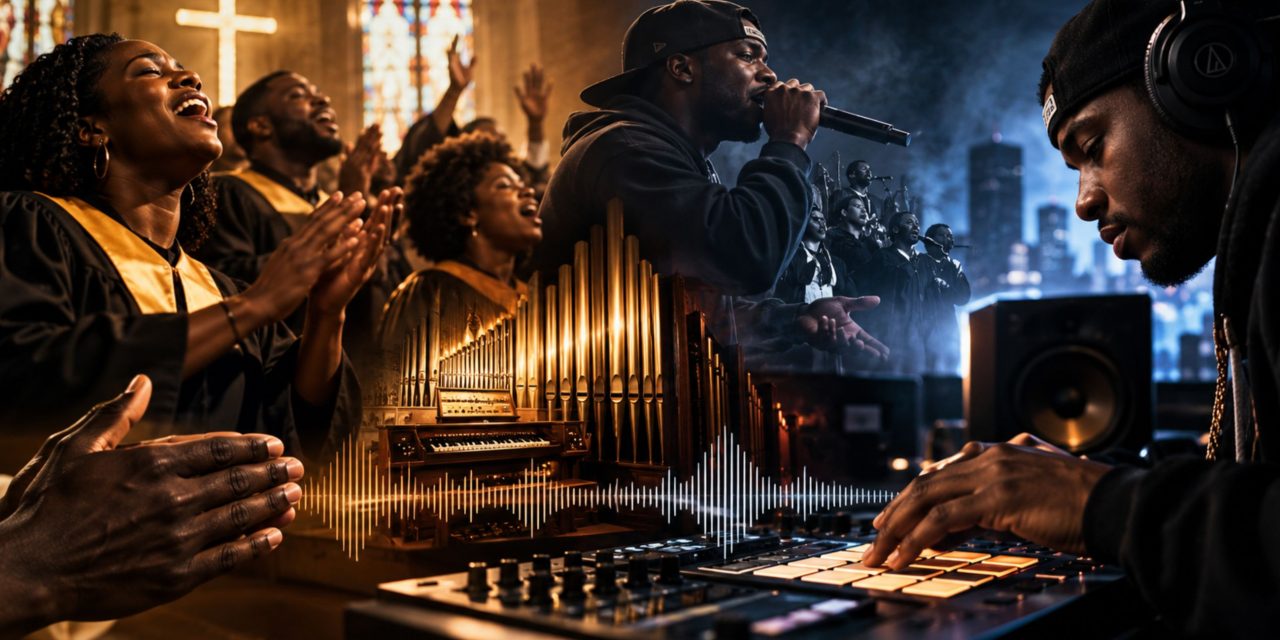
Black gospel music and trap may sound like distant relatives, but their family tree is surprisingly close. Both carry Black rhythms, oral traditions, and powerful forms of musical exchange.
That history helps explain the roots of traditional Gospel trap music, where church traditions meet modern hip hop production. The connection goes far beyond putting a choir sample over an 808.
The Historical Connection Between Gospel and Trap
The ring shout provides one of the earliest examples of the rhythmic traditions behind this connection. In the 1800s, participants formed circles and stomped and clapped together without instrumental accompaniment.
Those physical rhythms created a powerful musical pulse. Generations later, similar rhythmic instincts appeared in forms of popular Black music, including hip hop and trap.
By the 1950s, gospel quartets pushed these ideas further. Groups such as The Soul Stirrers developed tight harmonies and rolling rhythms that filled churches with sounds people could physically feel.
The instrumentation eventually changed, but the rhythmic instinct remained. That makes the comparison between gospel handclaps and trap’s 808 particularly interesting. The sounds are obviously different, yet both can provide a steady pulse anchoring everything around them.
The rhythm stayed. The technology simply changed.
By the 2010s, producers and Christian hip hop artists increasingly placed trap production alongside worship themes and Scripture. The combination became familiar enough to develop its own recognizable identity.
That evolution helped create the foundation for traditional Gospel trap music, where familiar church influences could live comfortably inside modern beat production.
Black Gospel’s Roots in Oral Tradition and Call-and-Response
Call-and-response is another major connection between gospel and trap. Its roots reach back through Black musical traditions, including field hollers and other forms of communal vocal expression.
The basic idea is simple. One voice makes a statement, and another voice responds.
That exchange remains central to gospel choirs and can also be heard in trap ad-libs. The delivery has changed, but the conversation between voices remains.
Thomas Dorsey helped popularize this interactive approach within modern gospel music. His work demonstrated how a lead vocal could invite an immediate response from a congregation.
Decades later, Christian rappers such as KB have used a similar conversational instinct through ad-libs. His work demonstrates how a vocal prompt can interact with programmed drums instead of a traditional choir.
The tempo and technology may differ, but the underlying idea remains familiar.
Spirituals often moved at slower tempos, while modern trap frequently operates around 130 to 150 BPM. That faster pace gives contemporary artists room to layer Scripture, ad-libs, and rhythmic vocal patterns over rapid drum programming.
The result can feel modern without completely abandoning the musical language that came before it. Traditional Gospel trap music carries that same conversational spirit, translating an old communal tradition into a modern rhythmic language.
Early Hip-Hop’s Borrowings From Church Music
Hip-hop producers incorporated church sounds long before trap-gospel became a recognizable category. Organs, choirs, vocal phrases, and gospel records became valuable sources for producers searching for powerful textures.
That relationship between church music and hip hop helped create a foundation for later Christian hip hop production.
Pete Rock’s 1992 track They Reminisce Over You is one example of hip hop’s broader sampling culture and its use of rich musical source material. Gospel-influenced instrumentation and soulful textures helped shape the sound of early hip hop production.
The relationship became even more explicit with Kanye West’s “Jesus Walks” in 2003. The track drew heavily from gospel traditions while placing Christian themes inside a contemporary hip hop framework.
That combination demonstrated how church-influenced sounds could exist within mainstream rap without losing their emotional weight.
Chance the Rapper continued that conversation through his gospel-influenced work. His music frequently blends Christian themes with hip hop production, showing how sampling and modern beat-making can reinterpret familiar worship traditions.
The technology changed from live musicians to samplers, drum machines, and modern production software. The musical conversation, however, continued.
Conclusion
The relationship between Black gospel, hip hop, and trap is not simply about borrowing sounds. It is about musical traditions evolving while carrying pieces of their history into new generations.
The handclap became an 808. Congregational responses became ad-libs. Church organs and choirs found new homes inside hip hop production.
And somewhere along the way, the hymn and the trap beat realized they had more in common than anyone expected.
From handclaps to 808s, the beat has come a long way. But what other gospel sounds are hiding inside the music you love?
DLK Urban Gospel and Christian Hip Hop takes you deeper into the history, sounds, and artists connecting gospel’s past with hip hop’s future.