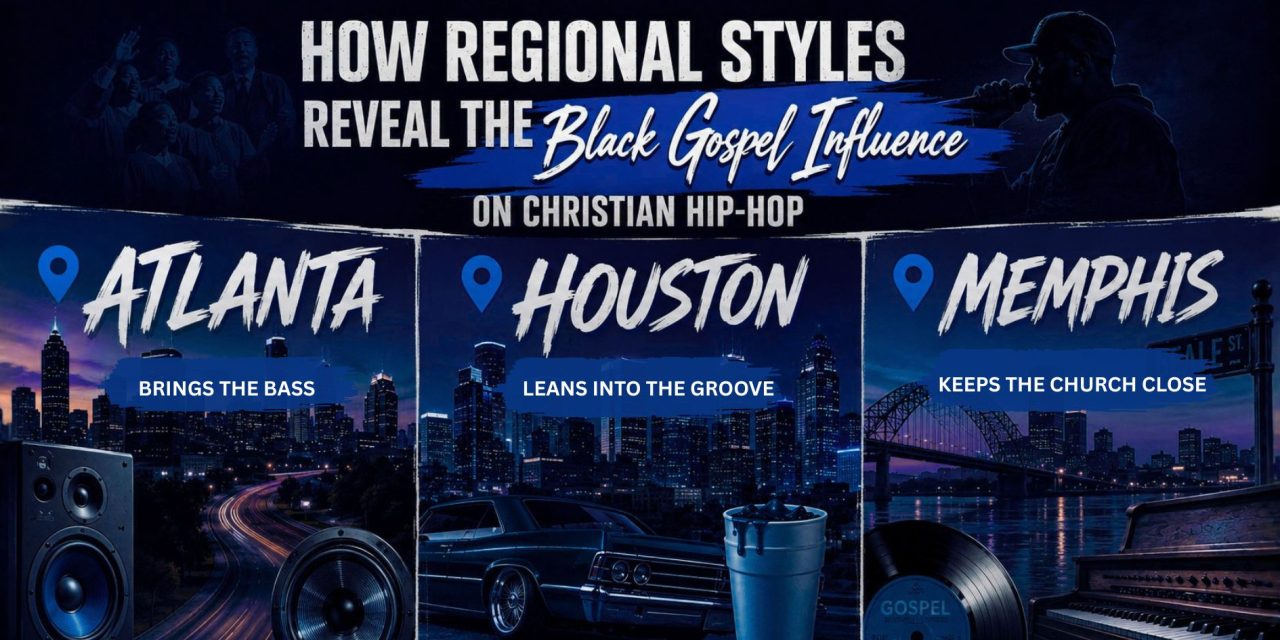
Christian hip-hop may share a message, but it certainly does not share one sound. Put an Atlanta, Houston, and Memphis beat side by side, and the differences arrive quickly.
Each city carries its own musical history into gospel-rooted hip-hop. Atlanta brings heavy bass, Houston slows the groove, and Memphis reaches toward church samples and Southern soul.
Together, these regional sounds reveal the Black Gospel influence on Christian hip hop. The influence isn’t always obvious, but it can surface through rhythms, vocals, samples, and how artists build a song.
Atlanta Brings the Bass
Atlanta’s influence on gospel-rooted hip-hop is hard to miss. The city’s familiar trap sound brings heavy 808s, crisp hi-hats, and forward-moving rhythms into Christian rap.
Many Atlanta records sit around 138 to 142 BPM, with sliding 808s adding movement underneath the beat. The production can feel modern and aggressive, while gospel influence remains tucked into the vocal arrangements.
A pitched-down choir loop can sit above the bass, retaining the familiar shape of a gospel quartet. The result feels distinctly Atlanta without abandoning the musical language of the church.
Tracks such as “City on a Hill” and “Hands High” from 2022 demonstrate how gospel phrasing can sit naturally inside bass-heavy Southern production.
The interesting part is how little needs to change. Black gospel music already carries strong rhythmic instincts, vocal responses, and powerful group vocals.
Atlanta producers simply give those qualities a different setting.
Houston Leans Into the Groove
Houston takes a different route. Rather than pushing the beat forward, the city’s hip-hop tradition often gives the music more room to breathe.
That slower approach can create a heavier, more relaxed feeling. Vocals have more space, while bass and melodic elements can stretch across the groove.
For Christian rappers, that creates room for storytelling. A rapper can sit deeper inside the pocket while gospel-inspired melodies add warmth around the verses.
Houston’s musical identity also connects with the tradition of chopped and slowed sounds. That history creates another path for gospel-rooted hip-hop to develop its own character.
The Black Gospel influence on Christian hip hop does not have to sound identical in every city. Local musical traditions can reshape the influence while keeping its underlying character.
Memphis Keeps the Church Close
Memphis has perhaps the most obvious relationship with its musical past. Producers continue drawing inspiration from Southern soul, gospel records, horns, and piano phrases. A short sample can become the emotional center of an entire beat.
That connection gives Memphis gospel rap a different kind of atmosphere. The production can feel gritty and modern while carrying echoes of older church recordings.
The original piece’s “Sunday Morning Coming Down” from 2023 captures that approach. Horn stabs create a call-and-response feeling while the drums retain the weight of Southern rap.
The sacred influence does not disappear. It simply moves through a different production language.
That is what makes Memphis particularly interesting. Producers can reach backward for sounds associated with church and Southern soul, then place them inside contemporary hip-hop.
Beyond the Big Three
Atlanta, Houston, and Memphis are only part of the story.
Other cities bring their own histories, accents, rhythms, and musical references into Christian hip-hop. Regional influence can show up through drum patterns, vocal phrasing, sample choices, tempos, or simply how an artist approaches a beat.
That variety keeps gospel-rooted hip-hop from becoming sonically predictable.
An Atlanta rapper may approach a gospel sample differently from an artist influenced by Houston’s slower grooves. A Memphis producer may hear an old church record and imagine something completely different.
The result is a genre that can share a spiritual foundation while sounding remarkably different from city to city.
The Black Gospel influence on Christian hip hop becomes more interesting because it does not produce one uniform sound. It gives different communities material to reinterpret through their own musical identities.
Conclusion
Christian hip-hop continues to grow through the meeting of faith, local culture, and musical traditions.
Atlanta brings the bass, Houston creates space, and Memphis keeps the echoes of gospel and Southern soul close. Other cities will continue adding their own accents to the picture.
That variety shows how deeply Black gospel music continues to shape Christian hip-hop without determining exactly what the genre must sound like.
The influence can be heard in the samples, harmonies, rhythms, and communal spirit. Yet every city can still make that inheritance its own.
Ever heard a Christian hip-hop track and immediately thought, “That sounds like Atlanta,” before the artist even said where they were from?
DLK Urban Gospel and Christian Hip-Hop follows those unmistakable regional sounds, where gospel roots, local culture, and hip-hop come together in ways you can hear for yourself.