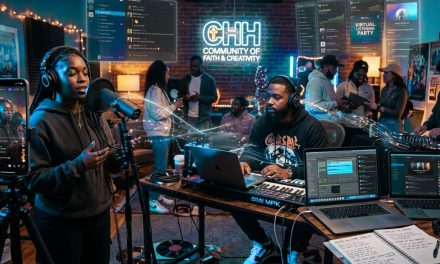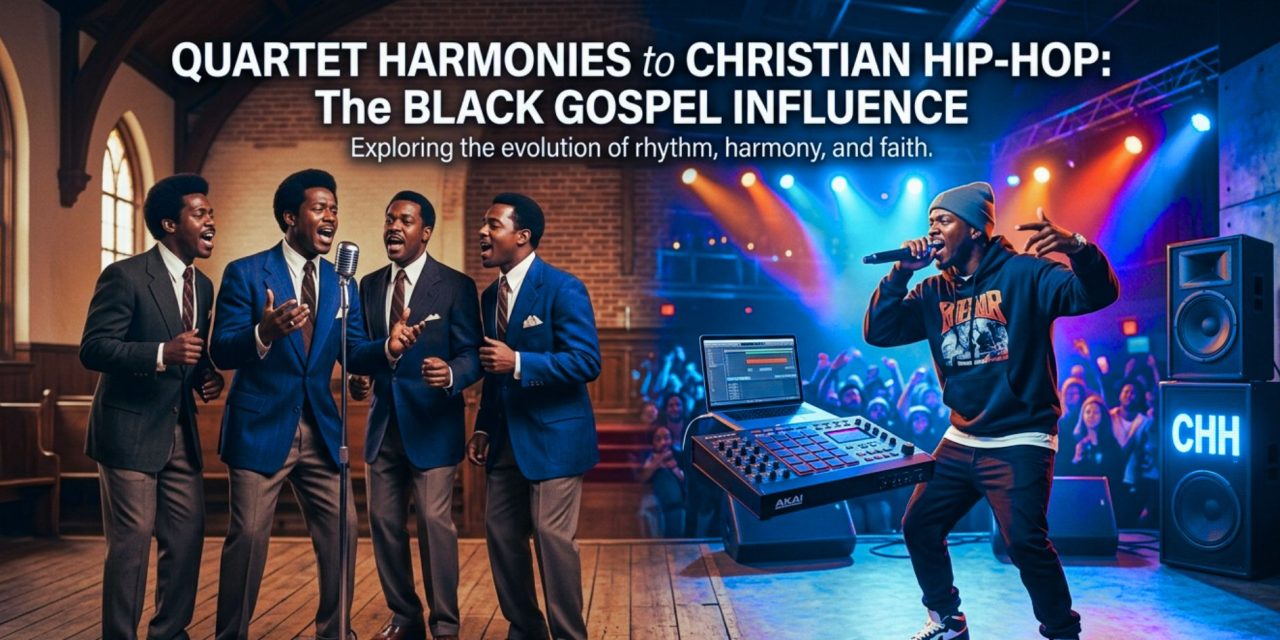
Long before Christian hip-hop artists delivered faith-filled verses over booming 808s, another sound was shaping hearts across the American South. It wasn’t built on drum machines, samples, or digital production. It was built on four voices singing in perfect harmony.
Southern Black Gospel created musical traditions that still echo throughout today’s Christian hip-hop. From layered harmonies and call-and-response worship to rhythmic phrasing and church-rooted storytelling, many of the genre’s defining characteristics continue to influence contemporary Gospel rap in surprising ways.
Understanding the Black Gospel influence on Christian hip hop helps bridge generations, revealing that today’s Gospel rappers are often carrying forward traditions established decades before hip-hop ever existed.
Quartet Tradition and Four-Part Harmony
Southern Black Gospel gained widespread popularity during the 1930s through four-part quartet singing. Groups such as the Dixie Hummingbirds and the Soul Stirrers captivated audiences using only their voices, creating rich harmonies without relying on instruments.
Every singer had a specific role:
- Lead carried the melody.
- Tenor added bright upper harmonies.
- Baritone connected the middle of the arrangement.
- Bass anchored the performance with powerful low notes.
Rather than using complex chord changes, quartet music often revolved around simple progressions built on the I, IV, and V chords. The magic came from how the voices blended together, creating warmth, movement, and emotional intensity.
Even today, producers occasionally sample vintage quartet recordings or recreate stacked harmony arrangements within Gospel rap choruses, proving that these early vocal traditions remain highly relevant.
Call-and-Response: The Language of the Church
One of Southern Black Gospel’s most recognizable characteristics is call-and-response.
Instead of music flowing in only one direction, worship became a conversation. A preacher or lead singer delivered a phrase, and the congregation answered back. As each response grew louder, the entire room became part of the performance.
This interactive style eventually found new life inside Christian hip-hop.
Modern CHH hooks frequently feature familiar responses like:
- “Amen”
- “Hallelujah”
- “Can I get a witness?”
Although today’s production may feature trap drums or atmospheric synths, the structure itself remains deeply rooted in Black church worship. It is another clear example of the Black Gospel influence on Christian hip hop, demonstrating that technology may change, but the conversation between leader and audience remains remarkably familiar.
From Church Choirs to Drum Machines
By the late 1980s, worship music in many churches began embracing new technology.
Drum machines, keyboards, and affordable recording equipment gradually replaced full live bands in smaller congregations. Devices like the Roland TR-808 and early Akai MPC samplers gave young musicians the ability to create complete arrangements without requiring multiple instrumentalists.
For many aspiring Gospel rappers, these affordable tools became the gateway into music production.
Instead of abandoning their musical heritage, producers simply expressed it differently. Quartet-inspired harmonies blended with programmed drums. Church organs shared space with sampled choirs. Traditional Gospel melodies found new homes inside modern hip-hop beats.
The production evolved, but the spiritual foundation remained intact.
When the 808 Became the New Organ
Perhaps one of the most fascinating transitions happened in the low end.
For generations, Hammond organs provided the deep foundation beneath Gospel worship. As hip-hop production matured, sustained 808 bass notes began serving a remarkably similar role.
Today’s Gospel rap producers often combine long, sustained sub-bass with short organ stabs or choir chords, creating a sonic blend that feels both modern and deeply familiar.
Rather than replacing traditional Gospel sounds, the 808 often complements them, preserving the emotional weight once carried by church organs while fitting naturally within contemporary production styles.
It’s another reminder that the Black Gospel influence on Christian hip hop extends beyond lyrics—it shapes the music itself.
A Legacy That Continues to Evolve
Christian hip-hop did not emerge in isolation. Many of its musical instincts, worship patterns, and emotional expressions can be traced directly back to Southern Black Gospel traditions that have been passed from one generation to the next.
Quartet harmonies, congregational responses, testimony-driven expression, and church-rooted musical phrasing continue to shape the sound of Gospel rap today. While modern production techniques have transformed how these ideas are presented, the spiritual DNA remains unmistakable.
As this series continues, we’ll explore how testimony songs, rhythmic repetition, Southern church cadences, and other defining Gospel traditions continue influencing today’s Christian hip-hop artists in ways many listeners may never have realized.
Every Gospel rap beat carries a story—and sometimes that story began decades before the first verse was written. Which traditional Gospel influence do you hear most clearly in today’s Christian hip-hop?
Join the conversation and discover more deep dives into Gospel music history on DLK Urban Gospel & Christian Hip-Hop.