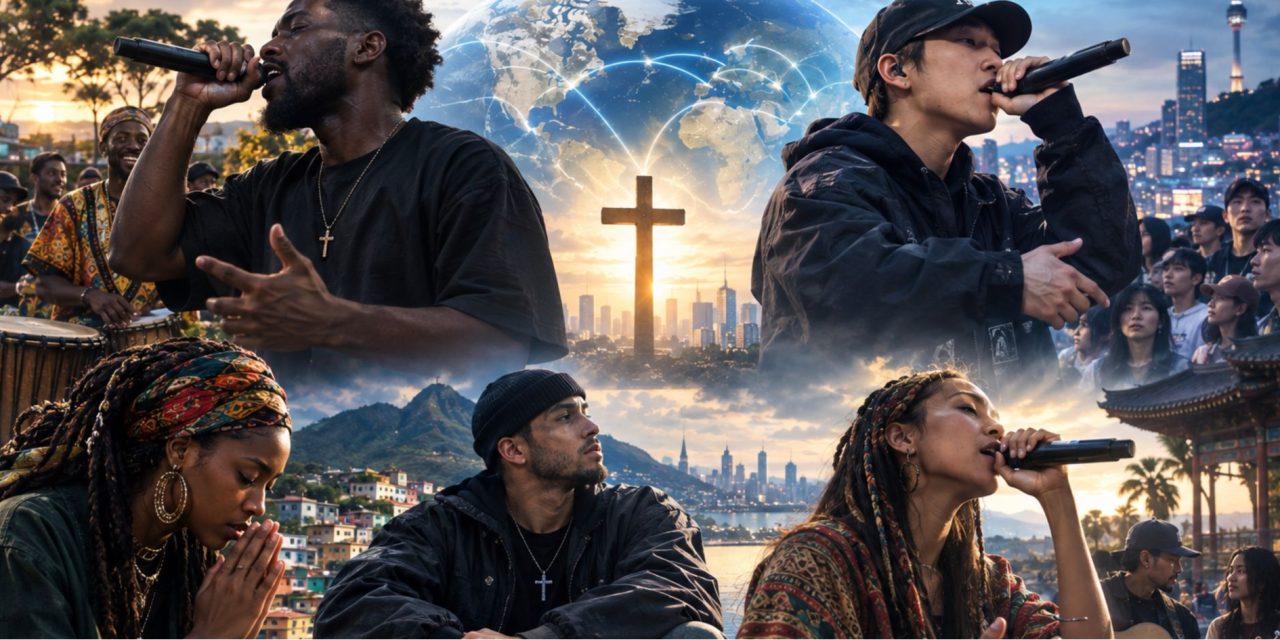
A Christian rap song can begin in Lagos, travel through London, and reach a listener who has never stepped inside an American church. The beat may change along the way, but the message can still feel familiar.
Christian Hip Hop is no longer shaped by one country’s sound or one community’s experience. Across Africa, Europe, Asia, and Latin America, artists are combining faith-based storytelling with regional musical influences, creating expressions that reflect where they come from.
The result is not simply American CHH reaching international listeners. It is a growing conversation in which local artists bring their own languages, rhythms, and testimonies to the genre.
Global Expansion Beyond the US
For years, Christian Hip Hop was often discussed through the lens of its American pioneers and record labels. That history remains important, but the genre’s development increasingly includes artists creating music in their own cultural and musical environments.
In Africa, Christian artists are blending rap with Afrobeats, Afropop, R&B, and other regional sounds. Nigerian artist Limoblaze, for example, has helped bring African musical influences into wider conversations about Christian Hip Hop. His work reflects how artists can combine faith-rooted lyrics with sounds familiar to their everyday audiences.
That combination matters because music often travels more easily when listeners recognize something within it. The rhythm may sound familiar, the language may feel close to home, and the message can still introduce a different perspective.
A listener in Nairobi may connect with a track through its Afrobeats groove. Someone in London may discover it through a collaboration, while another listener encounters it through a playlist or short video.
Digital platforms have made these connections easier to build. Artists can release music independently, collaborate across borders, and reach audiences without depending entirely on traditional radio or local distribution networks.
However, global expansion does not mean every region experiences CHH in the same way. Each community brings its own language, musical traditions, church culture, and understanding of hip hop.
That variety is part of what makes the genre’s international development worth following.
International Artists and Markets
The global story becomes more interesting when artists stop treating regional influences as something that must be removed to sound professional.
Instead, local musical identity can become part of the message. African rhythms, Korean hip hop, and other regional approaches can create Christian rap that feels rooted in a specific community rather than copied from another market.
South Korea, for instance, has its own Christian Hip Hop community. Rapper and pastor Dav1d has discussed the development of Korean Christian Hip Hop, including its relationship with church communities and the wider Korean hip hop scene.
His experience illustrates how Christian rap can function differently across cultural settings. In one place, an artist may focus on evangelism through personal testimony. In another, the music may become a way to explore identity, faith, social pressures, and everyday life.
The language changes, but the creative questions remain recognizable:
- How can artists communicate biblical themes naturally?
- How can regional sounds shape the production?
- How can Christian rap connect with listeners beyond church spaces?
- How can artists build sustainable communities around their music?
These questions apply to both established performers and independent artists working with limited resources.
Regional Sounds, Shared Message
International growth also creates room for collaborations that do not follow the traditional US-to-global direction. Artists from different regions can exchange production styles, languages, flows, and storytelling approaches.
A collaboration between African and European artists, for example, can introduce listeners to sounds they might not discover through their usual playlists. The same principle applies when artists from Asian or Latin American communities build music around their own cultural experiences.
The music does not need to sound identical to create a connection. In fact, the differences may be what make the collaboration memorable.
The Associated Press reported in 2026 that emerging Christian artists are blending rap, Afrobeats, and R&B while reaching younger audiences through streaming and social media. The report also highlighted how genre classification and limited industry representation remain challenges.
This creates an important distinction. Global reach is not simply about exporting one established sound to new listeners. It is also about making room for artists whose musical identities were shaped elsewhere.
Streaming, Social Media, and the Global Listener
A song no longer needs to travel through traditional industry channels before reaching an international audience. A short video, collaborative freestyle, playlist placement, or YouTube upload can introduce an artist to listeners thousands of kilometres away.
That accessibility has changed how artists build relationships with their audiences. Independent musicians can test ideas, share behind-the-scenes content, and release music without waiting for a major label to define their direction.
Social media also allows listeners to participate in the conversation. They can share lyrics, respond to testimonies, create videos, and introduce songs to their own communities.
For Christian Hip Hop, this creates opportunities beyond entertainment. A track can become part of someone’s daily commute, personal reflection, youth gathering, or conversation about faith.
Still, visibility does not automatically translate into a sustainable career. Artists need more than views and streams. They may also require reliable distribution, promotion, live opportunities, creative partnerships, and communities that support their work.
Streaming platforms can help listeners discover music, but long-term growth often depends on what happens after that first discovery.
Does the listener return? Does the artist build a genuine community? Can the music continue reaching people without losing its identity?
Those questions will remain important as CHH develops across international markets.
Conclusion
Christian Hip Hop’s global expansion is creating space for more voices, sounds, and stories. From African musical fusions to Korean Christian rap communities, artists are showing that faith-based hip hop does not belong to one country or one musical formula.
The genre’s future will depend partly on how well artists embrace their cultural identities while building meaningful connections across borders. Global growth should not require every artist to sound the same.
The most interesting developments may come from the places where Christian Hip Hop meets local rhythm, language, testimony, and lived experience. That is where the music can become more than an imported style—it can become a genuine expression of faith within a community.
A beat can cross borders without needing a passport—but can the message still feel personal thousands of miles from home? DLK Urban Gospel and Christian Hip Hop follows the voices, rhythms, and faith stories, giving Christian Hip Hop a genuinely global sound.