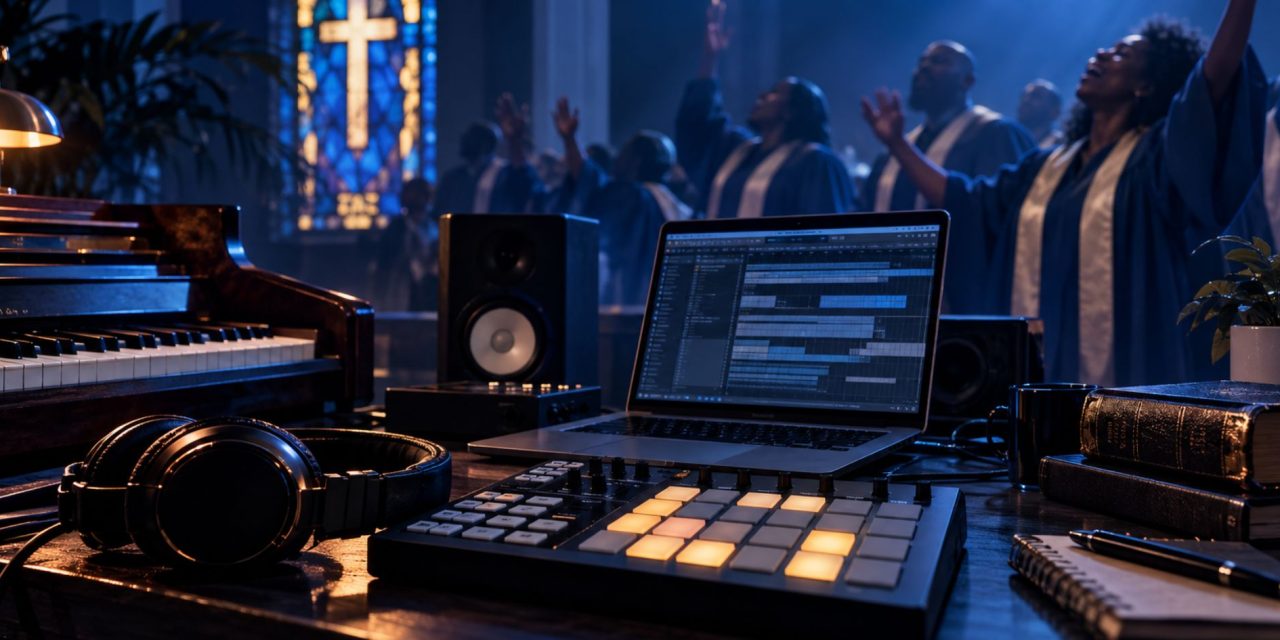
A producer presses three familiar chords, and suddenly the studio feels less like a booth and more like Sunday morning. Then the 808 slides underneath, the hi-hats scatter across the grid, and choir-inspired vocals begin to rise.
For many Black church musicians, these sounds are not discoveries. They are musical memories carried from services, rehearsals, and childhood songs into today’s urban beats.
That is where gospel harmony, praise-break energy, and church vocal arrangements meet modern production. The chords preserve something familiar, while the drums and vocal layers give that memory a new setting.
Chord Progressions Borrowed from Hymns
Some urban producers begin with harmony they already know by heart. A familiar chord shape can become the foundation for an entirely new arrangement.
The minor iv chord appears frequently in gospel-influenced music. Producers may transpose the progression into different keys, allowing singers to find a comfortable vocal range.
Progressions such as i–VI–III–VII can create a darker, reflective foundation. A producer might begin in A minor, then move to F minor when the hook arrives.
Another option is the i–iv–v–i progression. Its minor movement can support a restrained verse before the arrangement opens up during a bridge.
The VI–iv–i–v pattern offers another way to maintain a gospel-influenced harmonic character. Producers can shift the progression into a higher key when the ad-libs become more prominent.
These progressions are not exclusive to gospel music. Their impact comes from the way producers voice the chords, choose their sounds, and place them against the rhythm.
A clean piano, warm organ, or layered pad can make the harmony feel connected to church music. Trap drums then pull the arrangement into a different musical environment.
The chords provide the memory. The production gives that memory a new setting.
Drum Programming Influenced by Praise Breaks
Gospel influence does not stop with chord progressions. It can also shape the movement and intensity of a beat.
Praise breaks often build energy through repetition, rhythmic variation, and increasingly animated performances. Producers can translate that feeling into programmed drums without copying a live service note for note.
Hi-hat rolls may appear in short bursts every few bars. Instead of keeping every hit perfectly aligned, producers can introduce swing and timing variation for a more human feel.
A swing setting around 58 percent may create a loose groove in some sessions. However, the right amount depends on the tempo, drum samples, and overall arrangement.
Kick and snare placement can also shift as the track develops. A steady pattern might support the verse before additional percussion increases the intensity.
Automation can raise the tempo or create the impression of accelerating energy. Producers may also increase drum density, open the hi-hats, or introduce fills before the vamp.
For example, a track moving from 92 to 104 BPM across eight bars would create a noticeable rise. A producer could instead keep the tempo fixed and build momentum through arrangement changes.
The goal is not simply to make the beat busier. It is to recreate the feeling of a room responding as the music grows.
That approach often begins with observing how organists, drummers, and choir directors build energy during worship. The studio becomes another place to translate that collective movement.
Layering Vocals Like Church Choirs
Church choirs create fullness through harmony, repetition, and the interaction between different vocal parts. Urban producers can adapt those ideas using modern recording and mixing techniques.
A three-part arrangement might place the alto slightly left, the soprano near the center, and the tenor slightly right. This creates separation while keeping the voices connected.
The exact panning positions should serve the recording. A 25-percent placement on either side may work for one arrangement, while a wider or narrower spread may suit another.
A single lead vocal can carry the verse. Several background singers may then enter during the chorus, adding harmonic weight and a stronger sense of occasion.
Doubling each part can increase thickness, but excessive layering may blur the harmony. Careful editing, timing, and volume control help preserve clarity.
On the final chorus, automation can raise the vocal stack gradually. A lift of 1.5 decibels might work in one mix, although the appropriate change depends on the arrangement’s existing dynamics.
The emotional effect resembles a choir building toward a powerful vamp. The difference is that the producer controls the movement through vocal layers, processing, and automation.
The finished mix can feel suspended between two environments. It carries the intimacy of a recording booth while reaching for the communal energy of a sanctuary.
Conclusion
Gospel and urban production can meet without either style losing its identity. Familiar chords provide emotional grounding, while trap drums and modern arrangements introduce new movement.
The strongest fusions often come from musical instincts rather than rigid formulas. A producer remembers a chord, a rhythm, or a choir arrangement, then reshapes it for a different audience.
That is where genre fusion becomes more than adding church sounds to an urban beat. It becomes a conversation between musical memory and contemporary creativity.
Ever heard a beat and thought, “Wait… I know that chord”? That familiar sound might be carrying more church history than you expected. DLK Urban Gospel and Christian Hip Hop follows the gospel influences, production choices, and creative fusions making today’s urban Christian music feel both familiar and new.